Two Gazan women who passed through the newly reopened Rafah crossing with Egypt on Monday have conveyed their distressing experiences of security checks conducted by members of a local Palestinian militia linked to Israel. Lamia Rabia, who was travelling with her children, described being escorted by Israeli forces from the border to a nearby checkpoint where she and others were searched by members of the Abu Shabab militia, also known as the Popular Forces.
They didn't speak with us, they only searched us and then we went to the Israelis, who questioned us, Rabia recounted, highlighting the unsettling collaboration between the militia and Israeli forces.
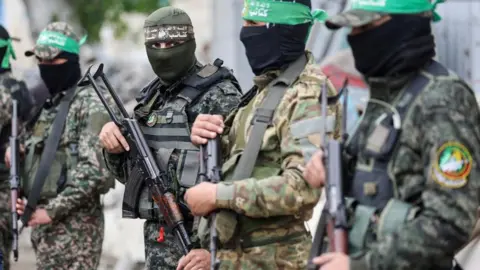
Concerns have escalated following claims that the Abu Shabab militia has assumed responsibility for the security checks at the Rafah crossing. Reports indicate that this group operates with support from Israel, further complicating the interaction between Palestinian civilians and military authorities.
The journey through the Rafah crossing has been fraught with difficulties, as only a small fraction of those intending to transit managed to cross. Despite expectations that 50 individuals would be able to return, a mere 12 were allowed passage on a recent day. The European Union, tasked with monitoring activities at the crossing, is contemplating measures to ensure the safe escort of arrivals.
The conditions of travel and the nature of security checks have brought significant attention to the humanitarian angle of the situation, with many evacuees’ personal belongings—including food, personal care items, and money—being confiscated by crossing officials.
While some individuals reported a smooth re-entry process, others detailed disturbing accounts of verbal abuse and mistreatment by militia members, raising questions about the integrity and oversight of the crossing. As the Rafah crossing becomes operational, it poses a substantial test of governance and control in the region amidst the ongoing geopolitical tensions.