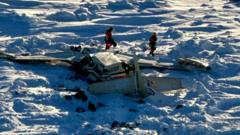
Crews are currently working to recover the bodies of 10 people who lost their lives in a tragic plane accident in Alaska. The Cessna Grand Caravan, operated by Bering Air, was on a flight from Unalakleet to Nome when it lost contact with radar. Jennifer Homendy, chair of the National Transportation Safety Board (NTSB), stated that the investigation is still in the preliminary phase, making it premature to determine the cause of the incident.
The aircraft was carrying nine passengers and a pilot when it went down approximately 34 miles southeast of Nome, a coastal city with a small population of around 3,500. Among the deceased were Rhone Baumgartner and Kameron Hartvigson, employees of the Alaska Native Tribal Health Consortium. The organization confirmed on Friday that the two were in Unalakleet for maintenance work on a local water facility.
During a news conference held in Anchorage, Homendy highlighted that rescue efforts are currently ongoing with the main focus being the recovery of victims. "We're sending our deepest condolences to those mourning their loved ones in this heartbreaking tragedy,” she expressed. However, recovery teams are facing harsh weather conditions and complications, as the wreckage is situated on an ice floe that shifts at about five miles per day.
The US Coast Guard reports that the aircraft was marked as "overdue" shortly after it was scheduled to land. Local volunteer fire departments noted that the pilot had informed air traffic control of his intention to hold until the runway was operational. Eyewitness footage showed significantly low visibility around the time the aircraft lost contact, coinciding with a rapid drop in altitude and speed.
Alaskan Senator Lisa Murkowski extended her condolences to the families impacted by the crash, emphasizing the close-knit nature of Alaskan communities. Governor Mike Dunleavy expressed his heartbreak over the loss, offering prayers for the victims and their families. The cities of Unalakleet and Nome lie about 150 miles apart across Norton Sound, underscoring the remote nature of the incident.
The aircraft, a Cessna Grand Caravan similar to a model shown in previous images, underscores the ongoing challenges of air travel safety in Alaska. The investigation continues as local officials, alongside Bering Air, extend their sympathies amidst this profound tragedy.
The aircraft was carrying nine passengers and a pilot when it went down approximately 34 miles southeast of Nome, a coastal city with a small population of around 3,500. Among the deceased were Rhone Baumgartner and Kameron Hartvigson, employees of the Alaska Native Tribal Health Consortium. The organization confirmed on Friday that the two were in Unalakleet for maintenance work on a local water facility.
During a news conference held in Anchorage, Homendy highlighted that rescue efforts are currently ongoing with the main focus being the recovery of victims. "We're sending our deepest condolences to those mourning their loved ones in this heartbreaking tragedy,” she expressed. However, recovery teams are facing harsh weather conditions and complications, as the wreckage is situated on an ice floe that shifts at about five miles per day.
The US Coast Guard reports that the aircraft was marked as "overdue" shortly after it was scheduled to land. Local volunteer fire departments noted that the pilot had informed air traffic control of his intention to hold until the runway was operational. Eyewitness footage showed significantly low visibility around the time the aircraft lost contact, coinciding with a rapid drop in altitude and speed.
Alaskan Senator Lisa Murkowski extended her condolences to the families impacted by the crash, emphasizing the close-knit nature of Alaskan communities. Governor Mike Dunleavy expressed his heartbreak over the loss, offering prayers for the victims and their families. The cities of Unalakleet and Nome lie about 150 miles apart across Norton Sound, underscoring the remote nature of the incident.
The aircraft, a Cessna Grand Caravan similar to a model shown in previous images, underscores the ongoing challenges of air travel safety in Alaska. The investigation continues as local officials, alongside Bering Air, extend their sympathies amidst this profound tragedy.