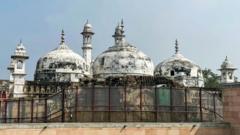
The Gyanvapi mosque in Varanasi has become a focal point of legal contention as India's Supreme Court reviews petitions challenging a decades-old law aimed at preserving the identity of places of worship from the time of independence in 1947. The 1991 Places of Worship (Special Provisions) Act prohibits altering the status of any religious site and generally prevents courts from litigating over ownership disputes, except notably for the Babri Masjid, whose demolition by Hindu extremists in 1992 sparked nationwide violence and disputes.
Recent cases, including one filed by a member of the ruling Bharatiya Janata Party (BJP), argue that the law infringes on religious freedom and secular principles outlined in the Constitution. This comes amid a troubling rise in petitions by Hindu groups challenging the legitimacy of several mosques, alleging they were built on sites of demolished temples. The situation poses a potential flashpoint for further religious conflict in India's diverse society.
Supporters of the Places of Worship law, including opposition leaders and Muslim organizations, emphasize its importance in protecting minority religious sites in a predominantly Hindu nation. They caution that any alterations to the law could lead to a surge of similar disputes, intensifying tensions particularly between Hindu and Muslim communities.
On Thursday, the Supreme Court instituted a temporary hold on new legal actions challenging the status of places of worship, with further arguments scheduled for February. The law stipulates that religious sites—ranging from temples to mosques—must remain as they were on August 15, 1947, aiming to quell rising intolerance during a period when sectarian violence was prevalent, particularly as the Babri Masjid conflict escalated.
The law's introduction was marked by an acknowledgment of the deep-seated animosities and challenges in maintaining communal harmony in India. Opponents of the legislation, including some BJP lawmakers, argued that it favored minority rights at the expense of Hindu sentiments, further complicating an already fraught religious landscape. Despite its intent to stabilize inter-religious relations, violence has recurred in response to disputes, such as those involving the Gyanvapi mosque, suggesting that the issue remains deeply sensitive.
Currently, the Supreme Court's ruling holds significant implications not only for the Gyanvapi and Shahi Eidgah mosques but also other contentious sites, tracking the unfolding of a legal journey rife with historical and cultural dimensions. The prospect of legal proceedings re-examining these deeply rooted religious sites continues to provoke a societal debate, as the implications of the court's deliberations on safety and communal relationships hang in the balance.