
In brief
Indian artists have historically infused Christian themes, particularly the Nativity, with their distinct cultural elements and Islamic motifs. Figures like Mughal emperors and modern artists like Jamini Roy and Angelo de Fonseca have created a dynamic body of work that reflects a harmonious blend of Eastern and Western influences, redefining Christian iconography within the Indian context.
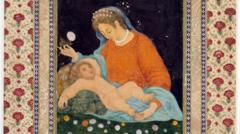
In an exploration of the intersection between modernism and Islamic motifs in art, Indian artists have carved out a unique vision of the birth of Jesus Christ, a theme predominantly represented in Western art. Over the years, their paintings—both conscious and subconscious interpretations—offer fresh perspectives on this pivotal biblical event. The introduction of Christianity to northern India can be traced back to Mughal emperor Muhammad Jalaluddin Akbar, who invited Jesuit missionaries to his court, bringing with them European scripture and art. The Mughal rulers' desire for religious coexistence inspired them to commission Christian-themed murals, where court painters began to blend Islamic features with the nativity scene. Neha Vermani, a historian, notes a significant painting depicting emperor Jahangir within the nativity, reinforcing the Mughal ideal of 'just' rule and harmony across faiths.An example of this artistic synthesis is an 18th Century Mughal-style painting showcasing vibrant colors and detailed ornamentation, typical of Mughal artistry. Furthermore, artist Jamini Roy, born in 1887 in West Bengal, is renowned for developing a unique artistic language that merges Bengali folk art with Kalighat styles. Ashish Anand, CEO of DAG art firm, highlights that Roy portrayed Christ as a Santhal figure, finding resonance in the simplicity and sacrifice embodied in Christ's life.Angelo de Fonseca, another notable artist born in 1902 in Goa, also contributed to a distinct Christian iconography reflecting his Indian heritage. De Fonseca depicted Mary as an Indian woman in traditional clothing rather than the conventional fair-skinned maiden. His work sought to reclaim Christianity from its Western depiction, aiming to embed it firmly within Indian cultural narratives. Rinald D'Souza, director of Goa's Xavier Centre of Historical Research, emphasizes that Fonseca's watercolors reimagined Christianity in an Indian context, highlighting his longing for Christian themes to resonate with local audiences.This melding of Western and Eastern influences by Indian artists not only revitalizes the representation of Christ's birth but also enriches the broader discourse on cultural interplay in religious art.