In brief
At Umm Al Qaiwain University’s College of Mass Communication, students organized a dialogue session to address the rapid spread of misinformation during crises. The discussion, part of their graduation project “Truth in Times of Crisis: From Rumor to Smart Response,” brought together senior officials and researchers who examined how artificial intelligence and other smart tools can detect, verify, and counter false content while emphasizing the need for a culture of verification and human oversight.
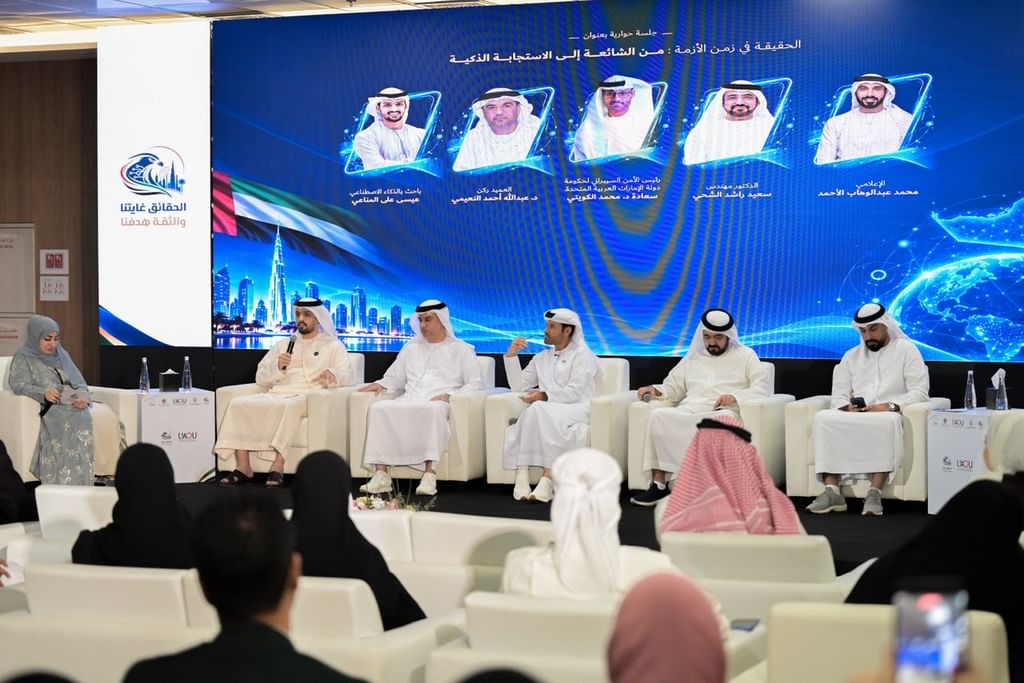
In the quiet corridors of Umm Al Qaiwain University’s College of Mass Communication, a small group of students gathered on 7 November 2026 to host a dialogue with senior officials and specialists from the fields of cybersecurity, policing, artificial intelligence (AI) and media. The event, part of their graduation project titled “Truth in Times of Crisis: From Rumor to Smart Response,” was set against the backdrop of a country that has seen the rapid proliferation of digital misinformation during emergencies.
The session brought together an impressive roster of key players: Mohamed Hamad Al Kuwaiti, the Head of Cybersecurity for the UAE Government; Brigadier-General Abdullah bin Salman Al Nuaimi, Deputy Director of the Operations Department at Ras Al Khaimah Police General Command; media professional Mohammed Al Ahmad; and research specialist Isa Al Manaei from TRENDS, who has worked on the cutting edge of AI-driven content analysis. Attendees also included Saeed Rashid Al Shehhi, whose work bridges media and technology in the Emirate.
Participants shared a common concern: that during crises—be they natural disasters, political upheavals, or health emergencies—the spread of false or misleading information can outpace authoritative responses. Al Kuwaiti stressed the role of rapid verification, warning that “rumours can spread so quickly that they reach a critical mass before serious authorities have a chance to investigate or refute them.” He spoke of the need for collaborative tools that allow cyber units and media outlets to cross‑check data in real time.
Brigadier‑General Al Nuaimi highlighted the policing side of the issue, noting that law enforcement agencies increasingly rely on automated systems to sift through millions of social‑media posts. He cautioned that “technology alone cannot guarantee trust; the public must see that the tools being used are transparent and accountable.”
Al Manaei took the floor to outline advances in what he calls “intelligent systems.” He explained that modern AI models go beyond simple question answering; they can search multiple databases, generate text, images and video, and even perform complex tasks with a degree of autonomy. “These capabilities provide significant opportunities to accelerate work, improve analytical efficiency and support decision‑makers, journalists, and researchers,” he said. Al Manaei also warned that the same abilities that give these systems their power also make realistic digital content easier and less costly to produce, which can intensify misinformation risks.
During the discussion, the participants underscored how crises are a perfect storm for misinformation, as the heightened demand for information often leads to a relaxation of the time people spend verifying content. Al Manaei emphasized that “the speed at which misinformation can spread through social media means that authorities or media organisations have to act in a matter of minutes to prevent damage.