In brief
US and Chinese scientists have made a significant breakthrough, revealing that volcanic activity once occurred on the far side of the Moon billions of years ago, based on analyses of rock samples returned by China's Chang’e-6 mission.
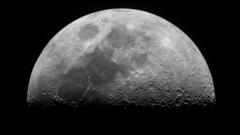
The investigation, detailed in the esteemed journals Nature and Science, highlights the discovery of basalt fragments aged over 4.2 billion years, illuminating the geological mysteries of the Moon's hidden terrain. While volcanic activity on the near side of the Moon, visible from Earth, has long been recognized, the far side presents a vastly different geological landscape, largely unexplored until now.The Chang’e-6 mission, which spanned nearly two months fraught with challenges, successfully collected the first rock and dust samples from the far side of the Moon. Researchers from the Chinese Academy of Sciences utilized radiometric dating techniques to assess the age of the volcanic rock, uncovering a surprisingly younger eruption that occurred approximately 2.83 billion years ago, a phenomenon previously unseen on the Moon's visible side."This is an incredibly exciting study," expressed Professor Qiuli Li from the Institute of Geology and Geophysics in a detailed peer review. "This is the first geochronology study to come from the Chang’e-6 samples and will hold immense significance for the lunar and planetary science community."Despite commonly being referred to as the "dark side," this region of the Moon receives ample sunlight due to its tidal locking with Earth, resulting in the same face always turning toward us. The far side was first glimpsed in 1959 when Soviet spacecraft Luna 3 captured grainy images, shedding light on its enigmatic surface. Since then, higher quality images have been transmitted, including remarkable NASA footage showcasing the far side and Earth in the background.Earlier in 2023, the Chang’e-6 mission included a small rover that successfully took a selfie of the lander, further documenting the far side’s rugged landscape. The findings from this mission not only deepen our understanding of the Moon's geology but also open new avenues for exploration and research beyond our planet.In summary, these discoveries from the Chang’e-6 mission not only address long-held questions about the Moon's geological history but also serve as a springboard for future lunar explorations and advances in planetary science.