In brief
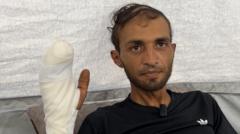
Mohammed al-Qedra's story reflects the desperate hunger situation in Gaza, as he recalls being shot while seeking food. With over 1,000 Palestinians reportedly killed in the last two months while trying to obtain aid, the ongoing humanitarian crisis worsens. International organizations have accused Israel of enforcing a devastating siege that exacerbates starvation in the region.
The article text follows:Mohammed al-Qedra, a 33-year-old Gazan, epitomizes the stark choices faced by individuals sacrificing their safety for survival. Recently shot in both his hand and leg at a food distribution center run by the Israel- and US-backed Gaza Humanitarian Foundation (GHF), he represents countless others who endure similar fates. “Hunger and the lack of everything makes us go there,” he told a BBC reporter. “We know that we might get injured or killed at any time, yet we still go there to get a kilo of flour.”Brought to a field hospital operated by British charity UK-Med, al-Qedra shared his harrowing experience, recounting his desperate plea for help after being shot. Despite his injuries, he remains resolute about returning to aid centers, stating, “The famine is bad for me and for everyone.”Data from the UN human rights office reveals that over 1,000 Palestinians have died in recent months while seeking food aid, with a significant number of fatalities occurring near GHF distribution sites. Israel has attributed the chaos near these sites to Hamas, claiming that troops only fire warning shots and do not intentionally target civilians. Meanwhile, the GHF has dismissed UN statistics, insisting they are “false.”As al-Qedra recuperates, healthcare professionals are exasperated by the escalating situation. British paramedic Sam Sears described the UK-Med hospital as overwhelmed, treating around 2,000 emergency cases monthly, many resulting from gunfire related to food crises. Dr. Aseel Horabi, a Palestinian medic, expressed her frustration with the dire conditions, revealing that some days she does not have enough food for herself. “We are living a disastrous situation,” she warned, noting the psychological toll on both patients and medical staff. Recent statements from over 100 international aid organizations accused Israel of reinforcing a "siege" on Gaza, contributing to mass starvation by blocking essential goods. The World Health Organization's Dr. Tedros Adhanom Ghebreyesus pointed out that mass starvation is an engineered crisis, primarily due to blockades.Since early March, a full blockade on aid to Gaza was reinstated, shortly followed by renewed military efforts against Hamas. Although some aid restrictions have eased, the situation remains critical. The WHO reports that one quarter of Gaza’s population faces famine-like conditions, with severe malnutrition affecting nearly 100,000 women and children. Despite claims from Israel stating that the crisis is not a famine caused by their policies but rather a shortage created by Hamas, many argue that the humanitarian disaster continues to worsen. With around 700 lorry loads of aid awaiting collection, UN agencies struggle to coordinate safe delivery amid ongoing violence, leaving Gazans increasingly vulnerable to starvation.