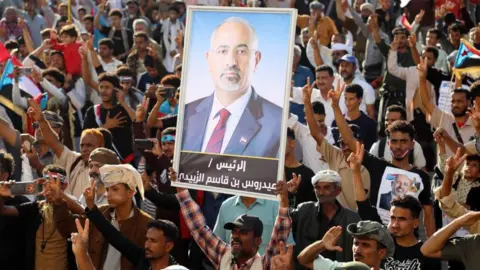
The Saudi-backed presidential council in Yemen has expelled the leader of a separatist group and charged him with treason after he failed to fly to Riyadh for talks.
Six other members of the presidency accused Aidarous al-Zubaidi, head of the United Arab Emirates-backed Southern Transitional Council (STC), of undermining the independence of the republic.
A Saudi-led military coalition said Zubaidi fled after not joining STC officials on a flight from Aden and moved a large force to al-Dahle province. Coalition aircraft launched strikes on the forces in response, it added.
The STC said the strikes, which reportedly killed four people, were unjustified and that Zubaidi was still in Aden.
It also expressed concern that contact had been lost with the group's delegation in Riyadh.
The past few weeks have seen southern Yemen moving to the brink of a new conflict, pitting factions battling the Iran-backed Houthi movement in the country's decade-long civil war against each other and deepening a rift between Saudi Arabia and the UAE.
STC-aligned forces have in recent years taken control of much of the south, which they want once again to be an independent state, by pushing out forces loyal to the internationally recognised government and the Presidential Leadership Council overseeing it.
In December, the STC's forces launched offensives to seize the eastern provinces of Hadramawt and al-Mahra from the government, saying they were necessary to restore stability in the south and combat the Houthis, al-Qaeda and Islamic State group.
However, Saudi Arabia warned last week that the advances near the kingdom's borders constituted threats to its national security as well as the security and stability of Yemen.
It also accused the UAE of pressuring its separatist allies to push into eastern Yemen and expressed support for a demand from the presidential council for all Emirati forces to leave.
At the same time, the Saudi-led coalition - which was formed in 2015 by Arab states, including the UAE, after the Houthis seized control of north-western Yemen - struck what it said was a shipment of weapons and military vehicles for the STC that had arrived from the UAE.
The UAE expressed deep regret at the Saudi accusations and denied there were any weapons, but agreed to pull its remaining forces out of the country.
Since then, forces loyal to the government have largely retaken control of Hadramawt and al-Mahra with the help of coalition air strikes.
To further diffuse tensions, Zubaidi and an STC delegation had been due to fly from Aden to Riyadh on Tuesday night for talks with the government. However, the coalition said the plane left three hours late without Zubaidi, who fled to an unknown location.
The legitimate government and the coalition received intelligence indicating that Zubaidi had moved a large force - including armoured vehicles, combat vehicles, heavy and light weapons, and ammunition - from the Jabal Hadid and al-Solban camps [in Aden] towards al-Dhale, coalition spokesman Maj-Gen Turki al-Malki said in a statement.
Coalition forces, in co-ordination with legitimate government forces and the [Saudi-backed] National Shield Forces, launched limited pre-emptive strikes to disrupt these forces and thwart Zubaidi's attempts to escalate the conflict and extend it into al-Dhale.
More than 15 strikes hit al-Dahle early on Wednesday and at least four civilians were killed, two hospital sources told AFP news agency.
Maliki also accused Zubaidi of distributing weapons to dozens of elements in Aden with the aim of creating unrest, and said the coalition had asked STC deputy leader Abdul Rahman al-Mahrami, who is also a member of the presidential council, to impose security there.
Later, the presidential council issued a decree saying Zubaidi had been stripped of his membership and referred to the attorney general for prosecution on charges including high treason, damaging the republic's military, political and economic standing, and forming an armed gang and committing the murder of officers and soldiers of the armed forces.
It has been established that [Zubaidi] has abused the just cause of the South and exploited it to commit grave crimes against civilians in the southern governorates, it alleged.
The STC's foreign affairs authority said in a statement that it had sent a delegation led by its secretary-general, Sheikh Abdul Rahman al-Subaihi, to Riyadh because it was committed to engaging positively and responsibly with various political initiatives and dialogue efforts.
At the same time, President Aidarous Qassem al-Zubaidi continues to carry out his duties from the capital, Aden, alongside his people, closely following up on and directly supervising the work of the military, security, and civilian institutions, it added.
The STC said it had been taken by surprise by the coalition air strikes in al-Dahle, describing them as an unfortunate escalation that is inconsistent with the declared climate of dialogue.
It also expressed concern that no official information had been received about the whereabouts and circumstances of Subaihi's delegation in Riyadh, which it said raises serious questions that require urgent clarification.