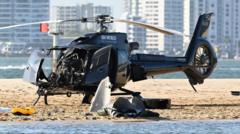
In January 2023, two helicopters collided in mid-air near the popular Gold Coast theme park, resulting in the death of four people, including two British tourists. Six more individuals sustained severe injuries in the crash, which occurred just moments after one helicopter had taken off and while the other was landing. The Australian Transport and Safety Bureau (ATSB) conducted a thorough investigation and identified that one pilot failed to receive a crucial radio communication shortly before the tragic incident.
The ATSB report highlighted issues with Sea World's operational changes that gradually compromised safety controls designed to manage air traffic, particularly the introduction of a new helipad and larger helicopters. The collision occurred approximately 20 seconds after takeoff, impacting the helicopter that was in the process of launching. The other aircraft managed to avert disaster and performed an emergency landing, but not without injuries to its passengers.
A key factor leading to the collision was a faulty radio antenna aboard the helicopter preparing for takeoff. The arriving helicopter's pilot either did not hear or receive an essential radio call indicating the airspace status. Despite a ground crew member informing the departing pilot that it was safe to launch, that information was outdated by the time the helicopter lifted off. Simultaneously, the pilot of the inbound helicopter spotted the other helicopter on the ground but did not recognize it as a threat, relying on radio communications that were unfortunately hindered by the malfunctioning antenna.
The victims included Diane Hughes, 57, and her husband Ron Hughes, 65, who were visiting family after a long separation due to COVID-19. Also among the deceased were 36-year-old Vanessa Tadros and 40-year-old pilot Ashley Jenkinson. In the aftermath, the pilot who successfully landed the other helicopter was praised by passengers for their quick thinking and expertise.
The ATSB's investigation produced 28 findings, emphasizing that operational changes in aviation, while seemingly beneficial, can lead to unforeseen complications that jeopardize safety. ATSB Chief Commissioner Angus Mitchell stressed the importance of careful implementation and management of changes to aviation operations to safeguard overall safety.
The ATSB report highlighted issues with Sea World's operational changes that gradually compromised safety controls designed to manage air traffic, particularly the introduction of a new helipad and larger helicopters. The collision occurred approximately 20 seconds after takeoff, impacting the helicopter that was in the process of launching. The other aircraft managed to avert disaster and performed an emergency landing, but not without injuries to its passengers.
A key factor leading to the collision was a faulty radio antenna aboard the helicopter preparing for takeoff. The arriving helicopter's pilot either did not hear or receive an essential radio call indicating the airspace status. Despite a ground crew member informing the departing pilot that it was safe to launch, that information was outdated by the time the helicopter lifted off. Simultaneously, the pilot of the inbound helicopter spotted the other helicopter on the ground but did not recognize it as a threat, relying on radio communications that were unfortunately hindered by the malfunctioning antenna.
The victims included Diane Hughes, 57, and her husband Ron Hughes, 65, who were visiting family after a long separation due to COVID-19. Also among the deceased were 36-year-old Vanessa Tadros and 40-year-old pilot Ashley Jenkinson. In the aftermath, the pilot who successfully landed the other helicopter was praised by passengers for their quick thinking and expertise.
The ATSB's investigation produced 28 findings, emphasizing that operational changes in aviation, while seemingly beneficial, can lead to unforeseen complications that jeopardize safety. ATSB Chief Commissioner Angus Mitchell stressed the importance of careful implementation and management of changes to aviation operations to safeguard overall safety.