In brief
With fears of job displacement due to AI automation, organizations are developing various labels to mark 'human-made' products amidst a growing backlash against AI use. Experts warn that without a unified standard, consumers could be left confused amid numerous competing claims of AI-free certifications.
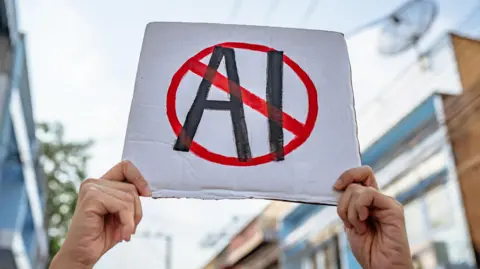
Organizations worldwide are racing to develop a universally recognised label for human-made products and services as part of the growing backlash against AI use.
Declarations like Proudly Human, Human-made, No A.I and AI-free are appearing across films, marketing, books and websites. This movement is a response to fears that jobs or entire professions are being swept away by a wave of AI-powered automation.
BBC News has counted at least eight different initiatives trying to devise a label that could gain the same global recognition that the Fair Trade logo has for ethically made products. However, experts caution that with numerous competing labels and confusion surrounding the definition of AI-free, consumers may find themselves bewildered unless a single standard is agreed upon.
Consumer expert Dr. Amna Khan from Manchester Metropolitan University emphasizes that clarity is crucial for building trust: AI is creating significant disruption and competing definitions of what is 'human made' are confusing consumers. A universal definition is essential to build trust, clarification and confidence.”
The movement's initiatives involve both non-profits and companies, with various labels available at no cost or minimal fees. While some labels can be downloaded with little to no auditing, others, such as those offered by aifreecert, require payment and a thorough vetting process through professional analysis and AI-detecting software.
Complications arise as AI increasingly integrates into everyday tools, making it challenging to define what constitutes 'human-made'. AI expert Sasha Luccioni asserts that the implementation of standards needs to be nuanced: AI is a spectrum, and we need more comprehensive certification systems, rather than a binary AI/AI-free approach.”
In the arts sector, significant pushback against AI tools has gained traction as generative AI products emerge—often at a pace and cost that eclipses traditional methods. For instance, the Bollywood studio Itelliflicks openly embraces AI in casting and script generation.
Novelty in transparency surrounds labels like Not By AI, used by film distributors to affirm the absence of AI in movie creation. Similarly, publishing giant Faber and Faber has begun stamping books as Human Written to clarify authorship origins amidst rapid AI advancements.
Books by People is fostering trust by demanding thorough vetting processes from publishers, ensuring transparency around authorship in an evolving literary landscape. Their methods reflect a growing consensus that as content created by machines becomes more prevalent, establishing standards and trust metrics for human versus AI-made work is essential.