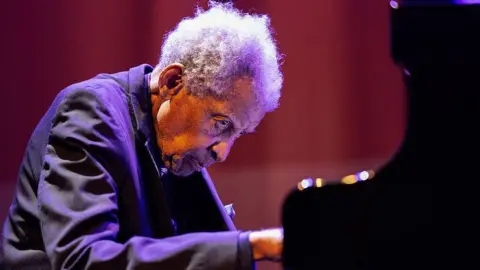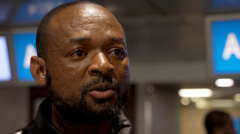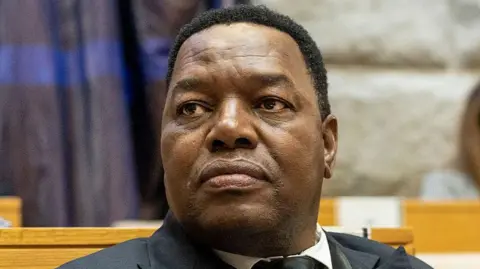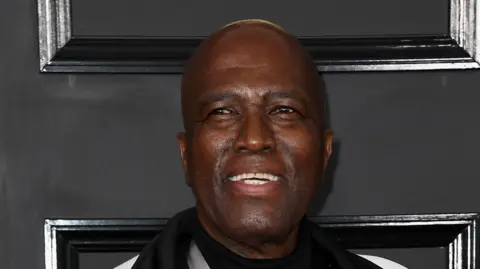
Albert Mazibuko, who sang in iconic South African group Ladysmith Black Mambazo for more than five decades, has died aged 77. The musician's death on Sunday came after a short illness, the choral group posted on their Facebook page.
Mazibuko joined Ladysmith Black Mambazo in 1969 and the collective went on to win five Grammy awards and feature on Paul Simon's acclaimed 1986 Graceland album. The group paid tribute to Mazibuko, describing him as 'kind to a fault' and a 'saint' who acted as a 'wise elder' for the younger members.
Mazibuko loved traveling the world and spreading the music of Ladysmith Black Mambazo, as he spoke often of their history and mission to spread 'peace, love and harmony'.
Born in uMnambithi (formerly Ladysmith), he left school early to work on a farm before joining the group founded by his cousin Joseph Shabalala in 1960. The group's unique style fuses indigenous Zulu songs with isicathamiya, a traditional acapella form.
Their career took off after a radio performance in 1970 led to a recording contract, and they released Africa's first gold-selling album in 1973. Their music resonated globally, particularly after joining Paul Simon for the Graceland album, amidst political controversy over the cultural boycott of apartheid South Africa.
Ladysmith Black Mambazo's songs offered hope and unity during the dark decades of apartheid, with Mazibuko recalling the harsh realities they faced. He reflected on his experiences with police and the oppressive nature of the regime, emphasizing the fear imposed on their community.
The current lineup of Ladysmith Black Mambazo continues to blend their longstanding tradition with newer members. The group recently wrapped up a tour in the US, showcasing their enduring legacy.
Mazibuko joined Ladysmith Black Mambazo in 1969 and the collective went on to win five Grammy awards and feature on Paul Simon's acclaimed 1986 Graceland album. The group paid tribute to Mazibuko, describing him as 'kind to a fault' and a 'saint' who acted as a 'wise elder' for the younger members.
Mazibuko loved traveling the world and spreading the music of Ladysmith Black Mambazo, as he spoke often of their history and mission to spread 'peace, love and harmony'.
Born in uMnambithi (formerly Ladysmith), he left school early to work on a farm before joining the group founded by his cousin Joseph Shabalala in 1960. The group's unique style fuses indigenous Zulu songs with isicathamiya, a traditional acapella form.
Their career took off after a radio performance in 1970 led to a recording contract, and they released Africa's first gold-selling album in 1973. Their music resonated globally, particularly after joining Paul Simon for the Graceland album, amidst political controversy over the cultural boycott of apartheid South Africa.
Ladysmith Black Mambazo's songs offered hope and unity during the dark decades of apartheid, with Mazibuko recalling the harsh realities they faced. He reflected on his experiences with police and the oppressive nature of the regime, emphasizing the fear imposed on their community.
The current lineup of Ladysmith Black Mambazo continues to blend their longstanding tradition with newer members. The group recently wrapped up a tour in the US, showcasing their enduring legacy.