Myanmar has denied committing genocide against the Rohingya people, asserting that The Gambia has not provided sufficient proof as it commences its defense at the UN's top court.
Ko Ko Hlaing, a representative of the Myanmar government, presented the argument in front of judges at the International Court of Justice (ICJ), labeling the allegations as unsubstantiated.
Earlier this week, The Gambia's foreign minister, Dawda Jallow, stated in court that Myanmar had aimed to eliminate the minority Muslim population through what he characterized as genocidal policies.
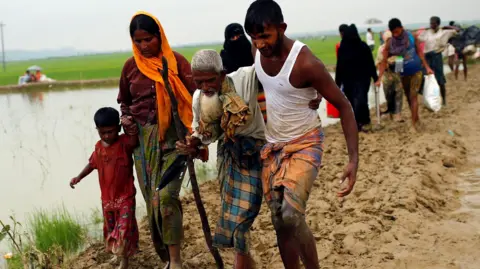
The violent military crackdown in Myanmar in 2017 resulted in the deaths of thousands of Rohingya and forced over 700,000 to flee to neighboring Bangladesh.
A damning UN report from the following year called for investigations into top military figures in Myanmar for genocide in Rakhine State and other crimes against humanity.
Myanmar, which has been under military control since the 2021 coup that overthrew the civilian government, has consistently rejected these findings, contending its actions were aimed solely at insurgent threats.
On Friday, Hlaing informed the ICJ that Myanmar could not remain passive while facing terrorist actions in northern Rakhine states, where many Rohingya reside.
Legal representatives for The Gambia alleged that the military's violent actions, including the killings and destruction of Rohingya settlements, cannot be justified under the pretext of combating terror.
When the court reviews... all of the evidence collectively, the logical conclusion is that genocidal intent has permeated Myanmar's actions against the Rohingya, argued Philippe Sands on behalf of The Gambia, which is supported by the 57-nation Organisation of Islamic Cooperation.
Currently, over a million Rohingya are refugees in Bangladesh's Cox's Bazar, home to some of the world’s largest and most crowded refugee camps.
While Myanmar expresses its commitment to repatriating refugees living in Bangladesh camps, it also cites external factors such as COVID-19 as barriers to its efforts.
Hlaing emphasized that a ruling of genocide would severely tarnish Myanmar’s reputation and significance, making the outcome of this case crucial for the country's future.
Witnesses, including Rohingya survivors, will be heard in closed sessions, with a final ruling expected by late 2026.
This landmark case is anticipated to set precedents for future genocide allegations, emphasizing the importance of the definition of genocide within international law.
The Gambia initiated the case in 2019, acting on a sense of responsibility derived from its own historical experiences with military rule.