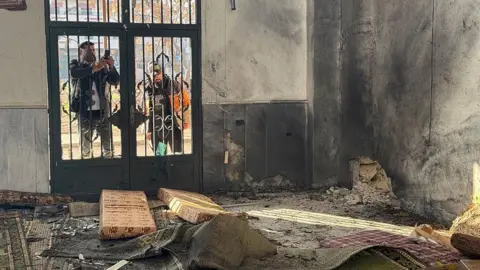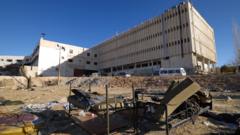
Saydnaya prison looms ominously on a hill just outside Damascus, its recently painted entrance adorned in the colors of Syria’s revolutionary flag—a grim reminder of the persecution endured by countless Syrians. As Jeremy Bowen reports, the dread experienced by the thousands entering these gates since the outbreak of war in 2011 is palpable. Estimates suggest that over 30,000 inmates have perished here, contributing to a staggering disappearance of more than 100,000 people, predominantly men but also including women and children, into Bashar al-Assad's notorious regime.
While other prisons under Assad’s control allowed some level of communication and family visits, Saydnaya stands out as the epitome of cruelty. The fear surrounding this facility has played a pivotal role in sustaining the regime’s oppressive hold over Syrians. Torture and anonymity became weapons of coercion, with families left unaware of the fates of their incarcerated loved ones.
Bowen recalls his experiences in other notorious prisons, noting that Saydnaya's abhorrent conditions are unrivaled. Overcrowded, with meager access to sanitation, detainees often faced unimaginable suffering. As the walls of Saydnaya have begun to crumble, so too have the barriers to uncovering the horrific truths embedded within.
In an urgent effort to document atrocities, volunteers, including musician Safana Bakleh, have taken it upon themselves to preserve what remains of evidence in the prison amidst the chaos. These passionate efforts come amidst fears that international human rights bodies have fallen short in their roles to investigate these crimes. Voices of anguish and hope fill the air as families sift through disorganized paperwork, seeking a shred of information that might deliver closure for those they've lost.
Safana expressed her commitment to those affected, emphasizing that even one confirmed death could offer solace to grieving families. The disarray of evidence reflects a desperate attempt to erase the regime's crimes, which now need to be cataloged for accountability.
Scarcely able to process the overwhelming realities within the prison, volunteers faced the stark conditions that had been overlooked for so long. For many, encountering the remnants of suffering drove them to tears, catalyzing a thirst for justice against those responsible for such inhumanity. Some families remained bleak but resolute, navigating through the prison in disbelief as they grasped for leads on missing relatives.
Amid the sorrow lies an emerging call for justice. As the dust settles on the regime's collapse, families and survivors articulate a vehement desire to see those accountable—especially Bashar al-Assad and his inner circle—face punitive measures for their heinous actions.
The massive scale of corruption that characterized the Assad regime has left a legacy of financial ruin and disarray for the future rulers of Syria. While individuals like Hassan Abu Shwarb have emerged from the shadows of torture with gripping tales of survival, they share a collective sentiment—justice is paramount for healing and moving forward.
Hope flickers amidst despair, with a desire for accountability acting as a catalyst for societal change. As Syrians face an uncertain future, the ghosts of Saydnaya linger, propelling the country towards a reckoning that will shape its path ahead.