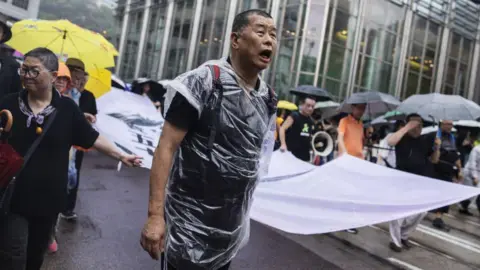
Hong Kong pro-democracy campaigner and media tycoon Jimmy Lai has been found guilty of colluding with foreign forces under the city's controversial national security law (NSL).
The 78-year-old, who has been in jail since December 2020, pleaded not guilty and faces life in prison, with sentencing expected early next year.
Lai used his defunct newspaper Apple Daily to lobby foreign governments for sanctions against Hong Kong and China, a court found.
Hong Kong's Chief Executive John Lee welcomed the verdict, asserting that Lai’s actions 'damaged the country's interests and the welfare of Hong Kongers', while rights groups condemned it as 'a cruel judicial farce'.
They argue that the NSL, which Beijing justifies as vital for stability, has been weaponized to quash dissent.
Judge Esther Toh stated there was 'no doubt' Lai harbored animosity towards the People's Republic of China, referencing efforts to solicit U.S. assistance to undermine the Chinese government.
Lai consistently denied the charges, emphasizing that he never used foreign contacts to influence policy regarding Hong Kong.
His trial, widely seen as a test of judicial independence in Hong Kong, comes amid increasing scrutiny over the judicial system, which critics argue has become an extension of Beijing's authority since the imposition of the NSL.
Lai's conviction is just one among many targeting pro-democracy advocates, reinforcing a climate of fear for those opposing the Chinese government.
Authorities assert the rule of law remains intact, but the nearly 100% conviction rate among those charged under the NSL paints a starkly different picture.
Rights advocates claim the law aims to silence dissenting voices, including those of key activists like Lai, whose health has reportedly declined during his imprisonment.
The global community, including Western governments, have urged for Lai's release, but such appeals have been met with staunch resistance from Hong Kong and Beijing.
As a leading figure of the pro-democracy movement, Lai’s case continues to evoke both local and international outcry, highlighting the ongoing struggle for freedom in Hong Kong.