
In brief
The groundbreaking digital unwrapping of a burnt scroll offers hope of reviving ancient knowledge hidden for centuries.
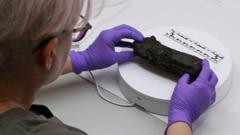
In a remarkable breakthrough, scientists have unveiled the first glimpse into a badly burnt scroll from the ancient Roman town of Herculaneum, once a vibrant community buried by the catastrophic eruption of Mount Vesuvius in 79AD. The scroll, which resembles a lump of charcoal due to severe charring, was considered too fragile for any physical examination. However, recent advances in imaging technology and artificial intelligence have finally allowed researchers to digitally "unwrap" the scroll, revealing text for the first time in two millennia.The initiative is part of the Vesuvius Challenge, an international competition aimed at deciphering the long-hidden texts of Herculaneum. According to Stephen Parsons, the project leader, "We’re confident we will be able to read pretty much the whole scroll in its entirety, and it’s the first time we’ve really been able to say that with high confidence." Early scans indicate that this scroll may contain philosophical works, with some Greek letters already discernible.Discovered among hundreds of carbonized scrolls in Herculaneum, these ancient documents, constructed from papyrus, have remained unreadable for centuries. Previous attempts to open them physically resulted in destruction. The University of Oxford's Bodleian Library harbors several such scrolls, which had been left untouched due to doubts concerning safe extraction methods.Encouraged by the potential of modern technology, researchers decided to examine a precious scroll using the Diamond Light Source synchrotron in Oxfordshire, where powerful X-rays can explore its inner layers without causing damage. "It can see things on the scale of a few thousandths of a millimeter," explained Adrian Mancuso, director of physical sciences at Diamond. The scanning process involves constructing a 3D model of the scroll's internal makeup, which is particularly challenging given that both the ink and papyrus are composed of carbon.After successfully identifying different layers, artificial intelligence was employed to detect the ink hidden within. This method involves the AI pinpointing slight differences that indicate the presence of ink, allowing researchers to digitally reveal the letters. "We can tell the entire scroll is full of text," Parsons stated, expressing optimism about deciphering substantial passages in future endeavors.The recent efforts have already yielded progress; during the previous year, a team from the Vesuvius Challenge was able to read approximately 5% of another Herculaneum scroll, also thought to discuss Greek Epicurean philosophy. As the team continues its work, they are hopeful of uncovering more textual treasures from the past.The reconnection with history has garnered excitement among researchers. Nicole Gilroy, head of book conservation, shared her thoughts on the significance of this project, stating, "There’s a real human aspect to it that I just think is really precious." As the ancient scrolls slowly reveal their secrets, they bridge the gap between past and present, offering insight into the philosophical pursuits of ancient civilizations.