In brief
A huge block of glacier has effectively blocked the route to Mount Everest just as the peak climbing season is commencing. Despite efforts by 'icefall doctors' to navigate around the ice, climbers must now wait for it to melt, delaying preparations and raising fears of congestion during ascents. Notably, prominent climber Purnima Shrestha is also facing challenges in her attempts to summit this season.
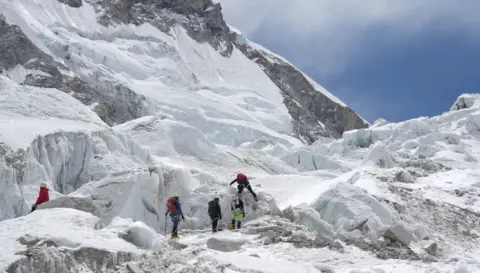
A huge, unstable chunk of glacier is blocking the route up Mount Everest from Base Camp in Nepal just as peak climbing season gets underway in the Himalayas.
Icefall doctors – who fix ropes and ladders on the lower part of the route up the world's highest peak - can find no way around the 100-foot-high (30m) block of ice just under Camp 1.
They say the only option is to wait for the ice block, called a serac, to melt – which they hope will happen within days.
The delay means preparations are weeks behind schedule for the spring season when weather for Everest ascents is usually at its best, and fears are growing that climbers will be queuing to reach the summit again this year.
Purnima Shrestha, a prominent climber and photographer from Nepal, is currently acclimatizing to summit Everest for the sixth time. We usually climb between Camp I, Camp II and Camp III back and forth during this acclimatizing process. Delays in the opening of the route have added concerns of possible 'traffic jams' to the peak this year, she told the BBC from Base Camp.
The icefall doctors work for the Sagarmatha Pollution Control Committee (SPCC), which is responsible for securing ropes as far as Camp 2 on Everest, which stands 8,848.86m (29,031 feet) above sea level. They reached Base Camp three weeks ago, but by this stage in April, they would normally have fixed the route as far as Camp 3, but remain blocked by the chunk of glacier about 600m below Camp 1.
According to Ang Sarki Sherpa, an experienced icefall doctor, the lower part of the serac is weak and is expected to melt, allowing climbers to continue their ascent. The Department of Tourism in Nepal is also considering the possibility of airlifting teams to expedite the opening of the route.
Despite the delays, numbers of climbers attempting Everest remain high as fees have increased this year to $15,000 (£11,105) for foreign nationals, while the number of permits issued thus far indicates a strong interest in summiting the iconic mountain.