In brief
A rediscovered painting by MF Husain shines at a Christie's auction, marking a significant moment in Indian art history.
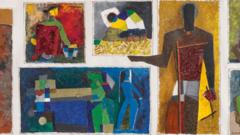
A remarkable rediscovered artwork by Indian maestro MF Husain, which went unnoticed for almost fifty years, has recently made headlines by shattering records in the art auction world. Husain’s grand mural, "Untitled (Gram Yatra)," measuring an impressive 14 feet in width, was sold for an astonishing $13.8 million (£10.6 million) at a Christie's auction held in New York last week. This sale has broken the previous record for Indian art set in 2023 when Amrita Sher-Gil's painting "The Story Teller" was sold for $7.4 million (£5.7 million).Husain, who passed away in 2011 at the age of 95, is often credited as a pioneering figure in Indian modernism, having inspired generations of artists. His work held a poignant significance, particularly after his departure from India in 2006, following threats from Hindu hardliners due to his artistic portrayals of religious deities.For years, "Gram Yatra" was hung in a hospital in Norway, unnoticed and undervalued, until its true worth was recognized. Created in 1954, this piece exemplifies Husain's unique artistic expression, capturing 13 vivid vignettes of Indian village life that merge folk traditions with contemporary influences. The painting utilizes rich, earthy hues to depict scenes of rural existence, portraying women engaged in daily activities and a farmer connecting with the land in a symbolic gesture. "If you're looking for a single artwork that defines modern South Asian art, this is it," remarked Nishad Avari, head of South Asian Modern and Contemporary Art at Christie's.Husain’s artistic journey evolved through various influences, including his travels, notably a trip to China in 1952, which inspired elements of calligraphy in his paintings. Following India's independence, Husain sought artistic inspiration in rural settings, reflecting Mahatma Gandhi's philosophy that the essence of the nation lay in its villages. According to biographer Akhilesh, the painting epitomizes the cultural essence of India, highlighting its societal fabric."Gram Yatra" also marks the emergence of Husain's distinct cubist style, characterized by geometric shapes and bold lines. The painting's intriguing story began when it was acquired in 1954 by Ukrainian doctor Leon Elias Volodarsky for just $295 during a World Health Organization mission in India. Its display at Oslo University Hospital for nearly fifty years rendered it largely invisible to the art community until Christie's became aware of the artwork in 2013, shortly after Husain's passing.As a result of this record auction sale, experts like Ashish Anand from Delhi Art Gallery believe that the value of Husain's body of work will see an upward trajectory. This event emphasizes the importance of Indian art not only for its aesthetic appeal but as a significant financial asset in the global market.