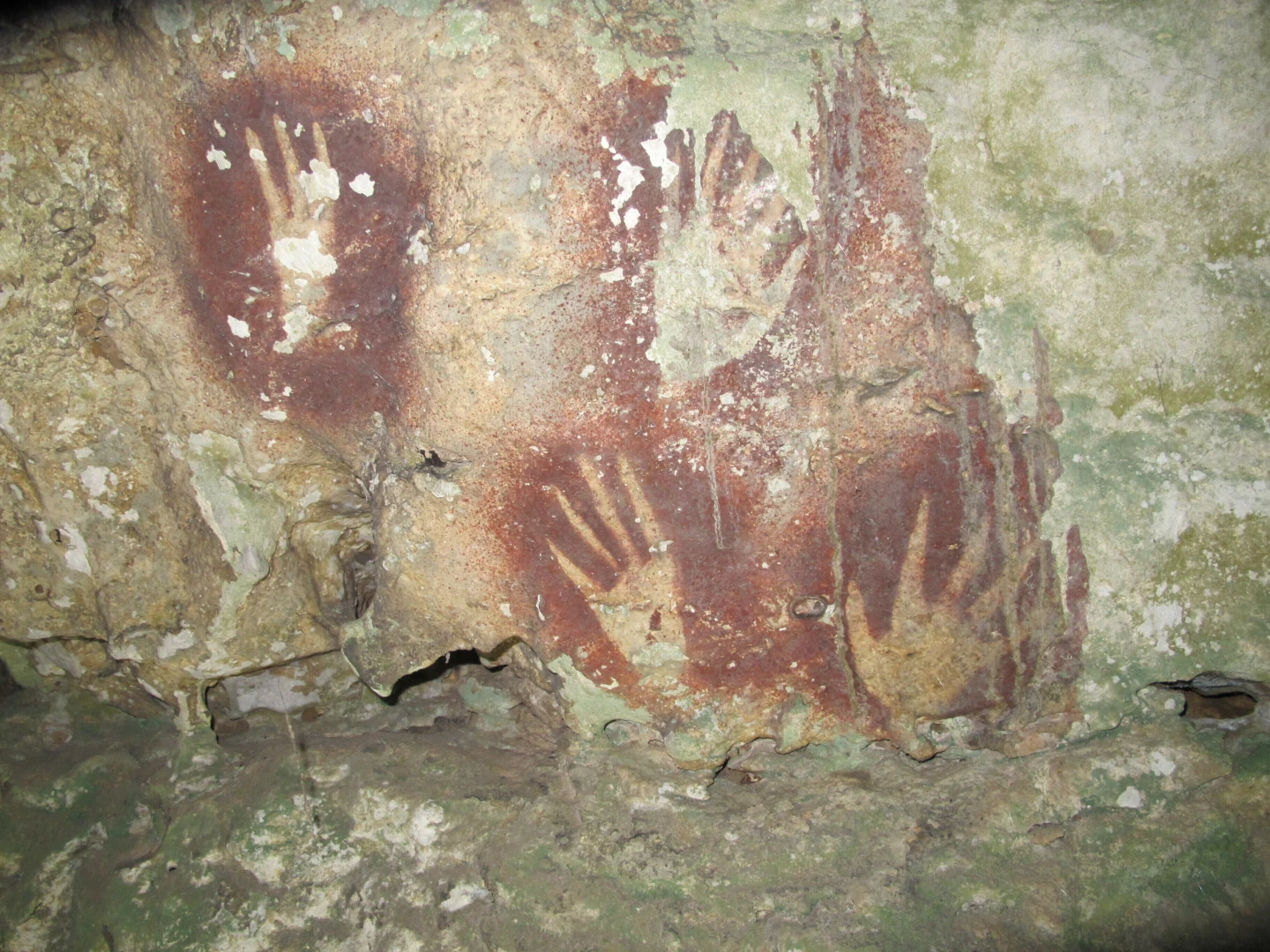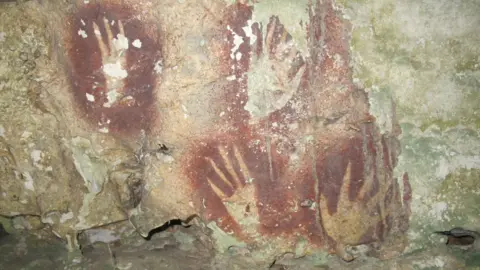
Researchers have identified a stenciled outline of a hand on Indonesia's Sulawesi island as the oldest known cave painting in the world. This red hand outline, estimated to date back at least 67,800 years, showcases a claw-like motif, signifying a remarkable evolution in symbolic imagination among early humans.
This finding predates the previous record-holder, a controversial hand stencil in Spain, by over 1,100 years, and provides compelling evidence that Homo sapiens may have reached the landmass of Australia–New Guinea, known as Sahul, around 15,000 years earlier than some researchers have theorized.
Over the last decade, discoveries in Sulawesi have reshaped the understanding of prehistoric art, indicating that the emergence of abstract thought and creative expression was not limited to Ice Age Europe but was present much earlier in various global regions.
Cave art serves as a significant milestone in the evolution of human thought, highlighting the development of narrative and imaginative capabilities akin to those that underpin language, culture, and scientific thought. Professor Adam Brumm, who co-led the research, argues that this latest discovery adds to the notion that the evolutionary journey of creativity originated in Africa rather than Europe.
The newly dated hand stencil, found in a limestone cave on the small island of Muna, demonstrates that the art scene in Sulawesi was not isolated. It likely reflects a far broader tradition of symbolic artistic expression present throughout the region.
This research not only alters the timeline of human creativity but also has profound implications for understanding the migration of early humans, suggesting they were making complex symbolic art long before settling in Australia. As ongoing studies continue to uncover more ancient art sites across Southeast Asia, they may further illuminate the cognitive capacities of our early ancestors.