
In brief
Friedrich Merz, leader of Germany's conservative party, has successfully secured a coalition deal with the Social Democrats, paving the way for a new government aimed at revitalizing Europe’s largest economy amidst ongoing challenges.
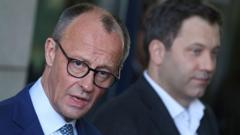
Germany's Conservative leader Friedrich Merz has finalized a coalition agreement with the Social Democrats after a five-month political hiatus following the previous government's collapse. Speaking to journalists, Merz emphasized that this collaboration is a "strong and clear signal" to Germany and the EU about their commitment to forming a decisive and action-oriented government.With Germany already grappling with a recession, exacerbated by economic turbulence from US trade tariffs under former President Donald Trump, Merz affirmed that the primary message to the international community is that "Germany is back on track." He is determined to enhance Germany's global competitiveness while meeting its defense commitments.Intense pressure has mounted on Merz and the Christian Democrats following their electoral victory in February, especially with the far-right Alternative for Germany (AfD) gaining ground in opinion polls. The new government collaboration is expected to address urgent issues such as migration and military readiness.During the announcement, Merz indicated that reforms aimed at controlling irregular migration and enhancing border security are included in the agreement, responding to public concerns raised during the recent elections. However, the AfD criticized these measures as insufficient, suggesting that Merz is yielding to Social Democrat influences.Concerns about Germany's military capabilities also prompted a significant focus within the coalition deal. Echoing the need for increased defense spending, Merz stated that the coalition plans to adopt a "Swedish model" of voluntary military service to bolster the Bundeswehr, Germany’s armed forces. While the coalition will comprise primarily newcomers to the cabinet, continuity is anticipated at the defense ministry under Boris Pistorius, who has been serving in the role.The coalition represents the fifth grand coalition since World War Two, but its leaders have stressed that this government will differ from past collaborations. Nevertheless, amidst economic stagnation, critics like Sahra Wagenknecht from the populist left have contested the coalition's ability to effectively tackle Germany's economic challenges, dubbing the situation "Merzession."While Merz expresses optimism about timely approval of the coalition deal by party members, recent polls reveal his conservatives in second place behind the AfD. As Germany prepares for this new chapter in governance, the implications for both domestic policies and international relations remain to be closely monitored.

