
In brief
The race to develop humanoid robots is heating up, as various manufacturers including China's Unitree and Tesla make strides in the technology, with significant implications for industries and daily life.
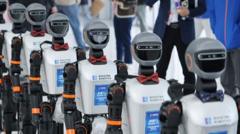
It's a lively spring morning in Hanover, Germany, and the anticipation builds as I make my way to meet a significant player in the world of robotics: the G1, a humanoid robot from Unitree, showcased at the Hannover Messe, a premier industrial trade fair. At just about 4'3" tall and budget-friendly compared to its counterparts, the G1 captures visitors' attention with its remarkable agility and has gone viral for its entertaining dance moves and martial arts skills.On this occasion, Pedro Zheng, Unitree's sales manager, operates the G1 remotely, offering insights into its functionalities. Users are tasked with programming the robot to perform autonomously. Curious onlookers interact with the G1, engaging cautiously yet playfully, in stark contrast to the majority of other machines present, highlighting the G1's humanlike attributes that generate comfort and curiosity.Unitree's innovation is part of a larger trend, with numerous companies globally competing to advance humanoid robotics. The potential benefits are tantalizing: a workforce that requires no vacation days could revolutionize labor dynamics. Moreover, these humanoid robots could become indispensable in households, performing chores like laundry or dishwashing.Nevertheless, achieving functional humanoid robots poses significant challenges. Unlike controlled factory environments where traditional robots have thrived, the unpredictability of domestic or public spaces complicates the integration of humanoid machines. Their design needs to ensure strength and safety; a simple fall could turn dangerous.A Unitree representative asserts, "AI for robots hasn't reached its breakthrough. Current robotic AI struggles with complex logical tasks.” Their G1 robot aims at research sectors and tech firms, leveraging open-source software for educational purposes.For now, many innovators are channeling their energy into humanoid robots suitable for factories and warehouses. Tesla's Elon Musk has attracted attention with his project, Optimus, aiming to manufacture “several thousand" this year for factory operations. Other automotive giants like BMW and Hyundai are also following suit, deploying humanoid robots in their facilities.Thomas Andersson, founder of STIQ, tracks dozens of companies working on humanoid technologies. He suggests that Chinese enterprises are poised to lead the market, attributed to strong supply chains and favorable R&D ecosystems. Unitree's G1 is cost-effective, priced at $16,000, and draws significant financial backing—60% of global funding for humanoid robots comes from Asia, with China benefitting from substantial governmental support.With these advantages, how might companies in the U.S. and Europe keep pace? UK entrepreneur Bren Pierce, who has founded three robotics ventures, recently revealed the KR1 robot, designed for industrial environments, though its manufacturing will happen in Asia due to cost considerations. "In Europe or America, you end up sourcing individual components from China, making local assembly inefficient."To minimize costs, Pierce's KR1 opts for a simpler design, lacking legs altogether, and uses widely available components to decrease expenses. He emphasizes that the true challenge lies in creating intuitive software for robots—a user-friendly interface that allows workers to operate these machines with minimal training.His KR1 robot aims to learn tasks through guided sessions with humans, a crucial feature for integration into workplaces. Pierce remains optimistic that humanoid robots will eventually make their way into homes, but it may take over a decade for fully autonomous models to become a reality.In summary, the journey into humanoid robotics is both promising and complex, with various companies forging ahead, but significant technical and social challenges remain before these machines can seamlessly integrate into everyday life.
