
In brief
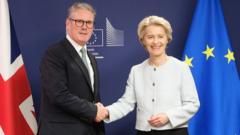
In early 2025, Prime Minister Sir Keir Starmer attends an informal summit with EU leaders, the first since Brexit negotiations. As geopolitical threats escalate, including conflicts in the Middle East and the resurgence of Donald Trump, the need for UK-EU cooperation is underscored. Despite goodwill in Brussels, skepticism about the UK’s willingness to compromise looms. The Labour government's promise of an "ambitious reset" raises questions about possible trade-offs regarding immigration and economic ties. With significant public support for closer relations, pressures mount on both sides to adapt. While defense cooperation seems achievable, economic adjustments may prove more challenging, necessitating political sacrifices on both ends.
The article text:Early in 2025, Prime Minister Sir Keir Starmer has been invited to an informal summit of EU leaders. It's a significant invitation, marking the first such event for the UK since the tense Brexit negotiations. This February meeting will focus on future security and defence cooperation, amid the volatile global landscape, including wars in the Middle East and the ongoing conflict in Ukraine, exacerbated by support from countries like Iran, North Korea, and China.The uncertainty surrounding European security is heightened by the possibility of Donald Trump's return to the White House, which threatens the cohesion of Western alliances and raises concerns about potential punitive tariffs on imports. These issues have reminded both the EU and the UK of their shared values during tumultuous times. Since Brexit in 2016, the EU has felt weakened by the loss of a major economy and its only significant military power, while the UK has become a smaller player on the global stage. Labour's government now realizes that strong ties with Europe are crucial to delivering on its promises to the UK public.The Labour government has frequently emphasized its intention to execute an "ambitious reset" of EU-UK relations. There has been considerable diplomatic activity since the summer election victory, with significant appearances from Foreign Secretary David Lammy and Chancellor Rachel Reeves at EU summits and meetings. This shuttle diplomacy signals a desire for closer collaboration.However, the meaning of this "reset" remains uncertain. Key questions loom about the potential for trade-offs between freedom of movement and economic benefits. An EU-UK summit is scheduled for spring, and various high-level diplomats indicate there is substantial goodwill towards the new Labour administration. Yet, skepticism persists over the UK government's commitment to making real compromises.The potential for defence and security arrangements presents a promising avenue for collaboration. Agreements on joint responses to cyber-attacks and military support for sanctions against Russia could formalize existing cooperation without the concerns of appearing to reverse Brexit.Labour's aspirations encompass economic and trade reform, particularly the need to mitigate the adverse effects of Brexit, estimated to cost the UK economy around 4% of its GDP long term. However, the UK's insistence on maintaining strict post-Brexit frameworks raises questions about genuine concessions.There is confusion in Brussels regarding the UK's "ambitious" reset claim, given its firm stance against rejoining the customs union or easing restrictions on free movement. Some EU diplomats believe that UK officials may inadvertently seek backdoor trade benefits through defense agreements, a notion rejected by the EU.Both sides will need to embrace compromises for any substantial economic relationship improvements. While the current Trade and Cooperation Agreement (TCA) is likely to remain intact, there is potential for simultaneous negotiations across various economic sectors. However, such agreements may necessitate some level of alignment with EU rules.Significant areas of negotiation include proposals for a Youth Mobility Scheme to facilitate work and study opportunities between the UK and the EU. Although the UK government has refrained from reinstating free movement, Labour has not entirely rejected this mobility scheme, leaving an open door for discussions.Potential compromises may also involve fishing rights negotiations, which could serve as leverage for more favorable terms on important UK interests. Labour is also looking to enhance trade connections in food and agriculture through potential veterinary agreements with the EU.On climate change, the UK and EU express mutual interest in addressing energy cooperation, notably in carbon emissions trading to safeguard UK businesses from nuances in EU regulations. Enhancing cross-border electricity market efficiency could yield significant economic benefits for both parties.In contrast, the EU expects the UK to take stronger measures against illegal immigration, an area fraught with political sensitivity for both sides. The EU opposes any plan allowing the UK to return migrants to their point of origin through EU countries.As efforts to improve EU-UK relations unfold in 2025, the pace will likely be slow due to various political challenges, compounded by a cautionary approach in bilateral negotiations. Yet, public sentiment in both the UK and EU indicates a strong desire for deeper cooperation; market responses to vulnerabilities and shifts in geopolitics signal potential for broader collaboration.According to a recent poll, a significant percentage of UK citizens favor strengthening ties with the EU to enhance the economy, security, and migration management, showing a willingness to relax pre-Brexit stances. Similarly, survey results reflect a desire among EU voters for the UK to have special access to the single market, signifying mutual interests at play.The rapid changes in public opinion triggered by geopolitical threats underscore the possibility for leaders in both regions to reconsider existing political boundaries. The challenge remains whether policymakers can adapt and respond to this evolving landscape effectively.

