In brief
Jung Woo-sung's recent admission of fatherhood with model Moon Ga-bi has stirred significant public discourse, spotlighting changing societal attitudes towards marriage and parenthood within South Korea's conservative framework. While some criticize the actor for failing to conform to traditional expectations, progressive voices advocate for acceptance of diverse family structures.
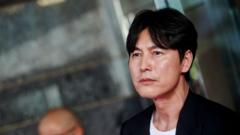
South Korean actor Jung Woo-sung, a prominent figure in the film industry, is at the center of a national conversation following the announcement that he has fathered a child with model Moon Ga-bi, to whom he is not married. The revelation, confirmed by Jung's agency on Sunday, has reignited discussions regarding celebrity behaviors and societal expectations on family structures in the culturally conservative nation. Jung, 51, acknowledged his responsibility as a father to the newborn son but remained silent about his plans for marriage with 35-year-old Moon, leading to a backlash from segments of the public who view non-marital births as taboo. The discourse intensified when Moon shared her experiences of an “unexpected” pregnancy via Instagram, sparking speculation surrounding Jung’s commitment.Public reaction has largely skewed towards criticism of the actor, whose celebrated career has made him a household name. Many lament his seemingly tarnished reputation, with some commentators on social media emphasizing that parenthood transcends mere financial obligations. One user on Naver News expressed disappointment that Jung, who previously held a clean public image, appeared to reject his child. This controversy has even permeated political spheres, with conservative lawmakers denouncing Jung’s actions as “unthinkable” within the context of South Korean social mores. An unnamed lawmaker from the People Power Party articulated that traditional values must be aligned with public sentiment, despite evolving attitudes.Contrastingly, there are voices of support for Jung, with some politicians advocating for personal choice in defining family structures. Lee So-young, from the Democratic Party of Korea, argued that marriage and cohabitation should not be assumed obligations given the unique nature of individual lives. She called for a more tolerant society, one that embraces differences without quick judgment.As progressive sentiments continue to gain traction, a recent social survey indicated substantial shifts in public attitudes, revealing that 37% of respondents now find out-of-wedlock childbirth acceptable, compared to 22% a decade ago. Notably, acceptance is strongest among younger demographics, with more than 72% of people supporting traditional marriage being over sixty.In light of this incident, long-standing societal norms in South Korea are being scrutinized. Major newspapers have echoed the call for a reevaluation of family structures, suggesting the discourse could pave the way for greater acceptance of diverse familial configurations in the future.As the South Korean entertainment landscape continues to evolve, the tension between celebrity lifestyles and ingrained public expectations remains a heated topic, raising questions over the responsibilities of public figures in shaping societal values.