
In brief
The remains of a 50,000-year-old baby mammoth, named Yana, have been discovered in Siberia, showcasing extraordinary preservation due to icy conditions.
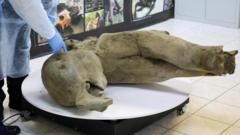
Russian scientists have made an astonishing find in the frigid landscapes of Siberia, unveiling the remains of a baby mammoth believed to be 50,000 years old. The well-preserved carcass, affectionately named "Yana" after the river basin where she was uncovered, was discovered in the sprawling Yakutia region during a summer thaw. Yana weighs over 100kg (15st 10lb) and measures about 120cm (4ft) tall and 200cm long. Scientists estimate she was just about one year old at the time of her death. Previously, only six comparable mammoth discoveries had come to light globally, with five in Russia and one in Canada. The remarkable find was made in the Batagaika crater, renowned as the largest permafrost crater in the world. Local villagers played a critical role in the discovery when they noticed Yana had nearly thawed completely. According to Maxim Cherpasov, the head of the Lazarev Mammoth Museum Laboratory, the residents ingeniously fashioned a makeshift stretcher to lift the mammoth from the ground. Typically, when permafrost thaws, the first parts to deteriorate, especially the trunk, are consumed by predators or birds. However, despite some damage to the forelimbs, Yana's head has remarkably remained intact. Researcher Gavril Novgorodov suggests that Yana probably became trapped in a swamp, which contributed to her exceptional preservation over millennia. Currently, Yana's remains are being closely studied at the North-Eastern Federal University located in Yakutsk, the regional capital. Tests are underway to establish the exact time of her death. This discovery is part of a wider trend, as ice-covered terrains in Siberia continue to yield similar prehistoric findings due to global warming. Recently, remains of a nearly 32,000-year-old saber-toothed cat and a 44,000-year-old wolf have also been uncovered in the same Russian region.
