In brief
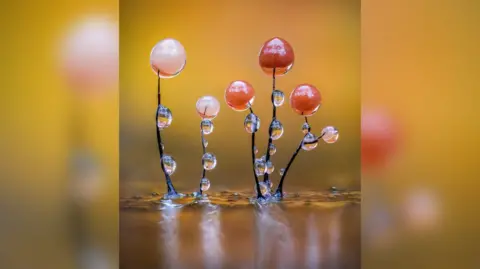
Barry Webb has transformed our understanding of slime mould through his stunning macro photography. By capturing their intricate details, he has showcased their ecological importance and earned accolades, including the people's choice award at the British Photography Awards 2025. Webb's journey into the fascinating realm of slime mould shows both the beauty of nature and the innovative techniques required to capture it.
Welcome to the world of slime mould. These images, captured by photographer Barry Webb, provide a close-up view of single-celled slime mould organisms. A view that would not be possible with the naked eye. Using a high-powered macro lens, and a composite of stills, Barry is able to reveal the tiny structures, which can grow anywhere from forests to deserts. Barry has won awards for his work, which is mainly focused west of London, including the recent people's choice award in the macro section of the British photography awards.Barry said he didn't know they existed before he was introduced to the world of slime mould in 2019. A gardener by trade but a keen hobby photographer, the Covid lockdown saw Barry spend more time outside hunting for these organisms. His photography focuses on the fruiting bodies of the slime mould, where the colour and drama are most intense, and from where spores are released. Barry explains how the slime mould feed off bacteria, algae, and types of fungi and are an important part of the ecosystem. Taking photos of slime mould is not a simple process, although technology has made it much easier in recent years. He describes how he uses a technique called focus bracketing, where dozens of photos are taken and combined to create a detailed final image. Barry Webb's stunning photography not only reveals the unique beauty of slime mould but also emphasizes its ecological significance, bridging art and science.