
In brief
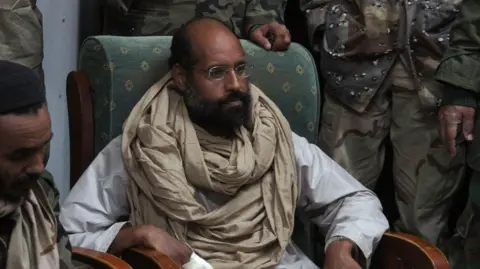
Saif al-Islam Gaddafi, the 53-year-old son of the former Libyan leader Muammar Gaddafi, has reportedly been shot dead, raising questions about the circumstances surrounding his death. His lawyer claims an assassination was conducted by a 'four-man commando' unit at his home in Zintan, while his sister suggests he died near the border with Algeria. Gaddafi was a significant figure in Libya's politics and international relations before and after his father was ousted in 2011.
Saif al-Islam Gaddafi, son of Libya's former leader Col Muammar Gaddafi, has reportedly been shot dead.
The death of the 53-year-old, who was once widely seen as his father's heir apparent, was confirmed by the head of his political team on Tuesday, according to the Libyan News Agency.
His lawyer told the AFP news agency a four-man commando unit carried out an assassination at his home in the city of Zintan, though it was not clear who may have been behind the attack.
In a competing version of events, his sister told Libyan TV that he had died near the country's border with Algeria.
Saif al-Islam Gaddafi was long seen as the most influential and feared figure in the country after his father, who ruled Libya from 1969 until being ousted and killed during an uprising in 2011.
Born in 1972, he played a key role in Libya's rapprochement with the West from 2000 until the collapse of the Gaddafi regime.
After his father's removal, Saif al-Islam Gaddafi - who was accused of playing a key role in the brutal repression of anti-government protests - was jailed by a rival militia in the city of Zintan for almost six years.
The International Criminal Court wanted to put him on trial for crimes against humanity for his alleged role in the suppression of opposition protests in 2011.
In 2015, he was given a death sentence in absentia by a Libyan court for his role in the crackdown.
He shaped policy and led high-profile negotiations despite having no official role in government, including those which led his father to abandon his nuclear weapons programme.
Such agreements saw international sanctions on the north African country lifted, and some considered Gaddafi a reformist and acceptable face of a changing Libya.
Gaddafi had always denied that he wanted to inherit power from his father, saying the reins of power were not a farm to inherit.
However, in 2021 he announced he would run for the presidency in elections which were then postponed indefinitely.

