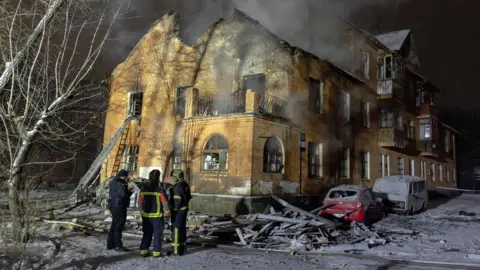
Russia has used the Oreshnik ballistic missile as part of a massive overnight strike on Ukraine. Four people were killed and 25 others injured in Kyiv on Thursday night, where loud booms could be heard for several hours, setting the sky alight with explosions. It is only the second time that Moscow has used the Oreshnik, which was first deployed to hit the central city of Dnipro in November 2024.
Russia's defence ministry stated the strike was in retaliation to a Ukrainian drone attack targeting Vladimir Putin's residence in late December—a claim Kyiv denies. While the ministry did not specify the Oreshnik's target, visual evidence showed multiple explosions in areas around Lviv shortly before midnight. President Volodymyr Zelensky confirmed that a ballistic missile had struck infrastructure in Lviv, approximately 60 kilometers from the Polish border.
The Oreshnik missile is known for its intermediate-range capabilities, possibly reaching up to 5,500 kilometers. It is designed to fragment during its descent, causing a series of blasts. Ukrainian foreign minister Andrii Sybiha labeled the strike a severe security threat to Europe, while highlighting Russia's military escalation as a consistent pattern throughout the conflict.
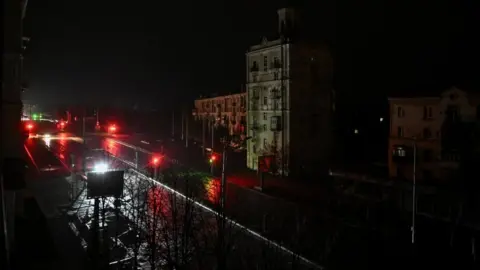
The attack on Kyiv involved 13 ballistic missiles designed to target energy facilities, alongside 22 cruise missiles and hundreds of drones, significantly impacting the city's infrastructure and leaving many residents without heat during the harsh winter. Ukrainian officials have called for international assistance to address the ongoing risk of such assaults, emphasizing that Russia's missile responses indicate a lack of desire for peace. Amid these strikes, an attack on a Qatari embassy building further exemplified the conflict's broad repercussions beyond immediate target areas.
Russia's defence ministry stated the strike was in retaliation to a Ukrainian drone attack targeting Vladimir Putin's residence in late December—a claim Kyiv denies. While the ministry did not specify the Oreshnik's target, visual evidence showed multiple explosions in areas around Lviv shortly before midnight. President Volodymyr Zelensky confirmed that a ballistic missile had struck infrastructure in Lviv, approximately 60 kilometers from the Polish border.
The Oreshnik missile is known for its intermediate-range capabilities, possibly reaching up to 5,500 kilometers. It is designed to fragment during its descent, causing a series of blasts. Ukrainian foreign minister Andrii Sybiha labeled the strike a severe security threat to Europe, while highlighting Russia's military escalation as a consistent pattern throughout the conflict.
The attack on Kyiv involved 13 ballistic missiles designed to target energy facilities, alongside 22 cruise missiles and hundreds of drones, significantly impacting the city's infrastructure and leaving many residents without heat during the harsh winter. Ukrainian officials have called for international assistance to address the ongoing risk of such assaults, emphasizing that Russia's missile responses indicate a lack of desire for peace. Amid these strikes, an attack on a Qatari embassy building further exemplified the conflict's broad repercussions beyond immediate target areas.