In brief
Paris hosted its inaugural Modest Fashion Week, showcasing the works of nearly 30 designers who specialize in garments that align with Muslim clothing principles. Attendees celebrated a diverse and inclusive fashion scene, challenging preconceived notions about modest attire in a city often fraught with political discourse surrounding religious clothing. Designers highlighted their collections, combining traditional aesthetics with contemporary influences, reinforcing the message that modest fashion is not only stylish but also empowering.
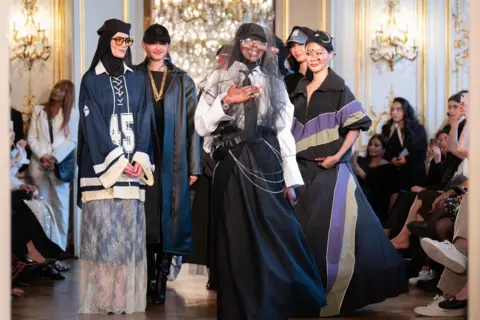
Paris has held its first-ever Modest Fashion Week, hosting nearly 30 designers whose collections include loose, long-cut garments and headscarves. It's the kind of clothing many Muslim women choose to wear in line with their religious principles - covering their arms, legs, and sometimes hair. The event is particularly significant in France, where hijabs and other religious clothing have made headlines and are restricted in certain settings.
Rukaiya Kamba, the creative director of Nigerian brand Flaunt Archive, emphasized the intentionality behind showcasing her collection in Paris. As models took to the runway, attendees expressed that the event illustrated a transforming and inclusive French culture.
France is home to an estimated 5-7.5 million Muslims, with organizers asserting Paris as a leading destination for modest fashion in Europe. In a historic venue situated near the Champs-Élysées, the collections focused on floral patterns and nature-inspired hues. Turkish designer Hicran Önal described her designs as romantic, while other designers drew inspiration from nature, yielding a spectrum of colors and styles.
The event not only defended the values of modesty but also placed it within the vibrant and increasingly popular context of contemporary fashion, including chic boxy silhouettes that reflect streetwear aesthetics. This new trend in modest fashion, resonating strongly with Gen Z and beyond, reflects a changing narrative in both style and societal acceptance.
Despite the challenges posed by France's strict secular laws which limit the visibility of religious symbols, designers like Fatou Doucouré presented a collection that empowered women who dress modestly, showcasing that they can take on diverse roles within society. The vibrant showcase was both a celebration and a reclamation of identity, illustrating a hopeful evolution in public perception.