
In brief
As firms like Unitree and Tesla ramp up efforts, the future of humanoid robots is uncertain yet promising.
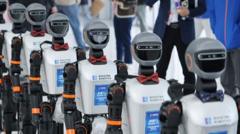
It was a vibrant spring day in Hanover, Germany, where the G1 humanoid robot, designed by the Chinese company Unitree, took center stage at the Hannover Messe—a leading industrial trade show. Standing at 4'3" (130cm), the G1 is not only more compact and affordable than many of its competitors, but it has also gained a following thanks to videos showcasing its impressive dance moves and martial arts skills. Pedro Zheng, Unitree’s sales manager, displayed the G1's capabilities, which include remote operation and the potential for autonomous functions through user programming. Attendees interacted eagerly with the G1, reaching out for handshakes and revealing an innate comfort with its human-like form, in stark contrast to the more intimidating robots present at the event.The global humanoid robot race is heating up, with numerous companies chasing the dream of creating robots that can take on various roles in homes and businesses. Humanoid robots promise significant advantages for businesses, as they do not require breaks or salaries, and the allure of having a robot manage household chores is enticing.However, integrating humanoid robots into more unpredictable environments, such as homes and dining establishments, presents unique challenges. According to a Unitree spokesperson, advancements in artificial intelligence are crucial, as current technologies struggle with tasks that demand logic and reasoning.While the G1 is primarily marketed to research groups and tech companies—encouraging open-source development—many startups focus on humanoid robots for industrial settings. For instance, Tesla’s Elon Musk has announced plans to produce thousands of humanoid robots named Optimus for factory use this year. Similarly, BMW has introduced humanoid robots in its US manufacturing plants, and Hyundai has placed large orders with Boston Dynamics.Thomas Andersson of research firm STIQ tracks a staggering number of companies developing humanoid robots, noting that most of the significant advancements and investments are occurring in Asia. Chinese manufacturers like Unitree benefit from a robust supply chain and significant governmental support, making it easier to innovate and develop.Conversely, US and European robotics firms face challenges, particularly with component sourcing from Asia. Kinisi, a robotics company founded by Bren Pierce in the UK, is responding by outsourcing production to Asia and simplifying robot design. Their KR1 model avoids the complexity of a full humanoid form, emphasizing functionality for industrial environments and utilizing widely available parts for cost efficiency.Despite efforts to innovate, even the optimistic Pierce predicts that a true household robot is at least 10 to 15 years away. He hopes for a future where robots seamlessly integrate into domestic life but acknowledges the complexities involved in achieving that goal.
