In brief
After a significant earthquake struck Japan, authorities have heightened their warnings about possible future megathrust earthquakes along the Nankai Trough, suggesting a 60-90% chance of such an event occurring in the next three decades. Residents are urged to prepare emergency kits while scientists emphasize that predicting exact timings for earthquakes remains highly uncertain.
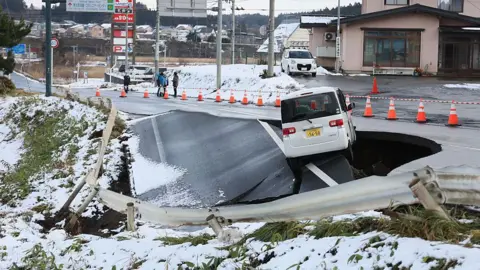
After a magnitude 7.5 earthquake struck north-eastern Japan on Monday, authorities again warned of the possibility of a future megaquake. It means that thoughts in Japan are turning to the 'big one' - a once-in-a-century quake.
In September, Japan's earthquake investigation panel said there was a 60-90% chance that a megaquake would occur in the Nankai Trough - an area of seismic activity which stretches along Japan's Pacific coast - within the next 30 years.
In April authorities had warned that a megaquake had the potential to trigger a tsunami of more than 20m (66ft) which could hit parts of Tokyo and other prefectures. They predicted that there would be around 300,000 deaths and trillions of dollars in economic damage.
So, what is the 'big one', can it be predicted - and is it likely to strike any time soon?
What did the latest warning say?
Officials urged residents in seven prefectures from Hokkaido in the north to Chiba in central Japan to stay on high alert for a potential megaquake. This is a vast area with millions of people.
A government official said there was a possibility that 'a large-scale earthquake with a magnitude of 8 or higher could occur as a follow-up earthquake' in the region. Authorities also told people to check evacuation routes, secure furniture, and prepare emergency kits, including food, water, and portable toilets. However, an evacuation order was not issued.
Japan's director for disaster management said at a news conference that global earthquake data suggests there's a possibility, not a prediction, of a larger tremor to come. Officials said the possibility of a larger quake occurring is about one in 100.
What is a megaquake?
Japan is a country used to earthquakes. It sits on the Ring of Fire and, as a result, experiences about 1,500 earthquakes a year. The vast majority do little damage, but there are some - like the one which struck in 2011 measuring magnitude 9.0, sending a tsunami into the north-east coast and killing more than 18,000 people.
But the one that authorities fear may strike in this more densely populated region to the south could - in the absolute worst-case scenario - be even more deadly. Earthquakes along the Nankai Trough have already been responsible for thousands of deaths.
These so-called 'megathrust' earthquakes tend to strike every hundred years or so, often in pairs: the last ones were in 1944 and 1946.
But can earthquakes actually be predicted?
Not according to Robert Geller, professor emeritus of seismology at the University of Tokyo. When authorities issued a megaquake warning last year, after a 7.1 quake struck southern Japan, Prof Geller told the BBC that the warning had 'almost nothing to do with science'.
This, he argued, is because while earthquakes are known to be a 'clustered phenomenon', it is 'not possible to tell in advance whether a quake is a foreshock or an aftershock'.
However, while it told people to be prepared, it did not tell anyone to evacuate. Indeed, they were keen to play down any massive imminent risk. 'The likelihood of a new major earthquake is higher than normal, but this is not an indication that a major earthquake will definitely occur,' the JMA said at the time.