In brief
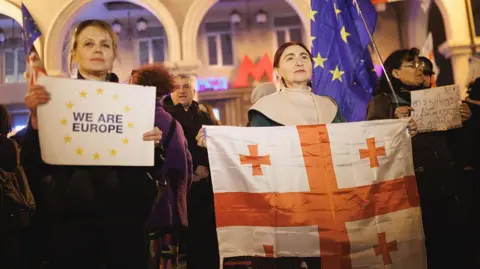
As Georgia marks a year of persistent protests against a government decision to halt EU membership efforts, protesters continue to gather despite escalating state repression. Many view their struggle as crucial not only for Georgia's future but also in the context of broader regional dynamics involving Russia and Ukraine. The protests have evolved from initial mass movements into a continual resistance against government efforts to suppress dissent, featuring increased arrests and severe laws targeting civil opposition.
One year after the government suspended its EU accession process, demonstrators in Georgia persist in their calls for democracy and European integration, defying oppressive measures.
I'm standing for the future of this country, says Giorgi Arabuli, who has taken part in protests in Tbilisi almost every night for a year.
Following the government's decision to halt EU membership progress on November 28, 2024, mass protests erupted, which were met with violent police crackdowns. Many demonstrators, like Giorgi, are adamant that they do not wish to return to the tumultuous days following Georgia's civil war influenced by Russia.
The protests reflect a deepening concern over what has been described as a dismantling of democracy in Georgia, prompting accusations of authoritarian governance akin to Russian rule.
Despite severe laws imposed by the Georgian Dream government designed to quell dissent, such as hefty fines and criminal charges against protesters, rallying crowds continue to gather nightly, showcasing their resolve. Recent legislative changes allow for harsher penalties, including imprisonment for those blocking streets.
Protests have also evolved tactics in response to the government's repressive measures, facing nightly arrests as demonstrators march through various streets of Tbilisi. Nata Koridze, whose husband is jailed as part of the government crackdown, notes the government's failure to extinguish the drive for democracy.
The belief that the Georgian government acts in Russia's interests resonates strongly among pro-European activists. Critics cite the ruling party's ties to Russia and suggest a deliberate shift away from the West’s influence, further exemplified by recent legislation mirroring Russian policies targeting civil society.
Amidst this political landscape, Georgia's path to EU membership appears increasingly bleak. The EU’s latest report characterized Georgia's status as a candidate as merely nominal, rejecting claims of forthcoming integration. Georgian officials have responded with increasing hostility to foreign criticism, underscoring their commitment to what they term a 'pragmatic' relationship with Russia.
The protests embody the hope and resilience of many Georgians, as they assert that their struggle is more than just an opposition to their government; it's a defining battle for the future of their country and its place in Europe.