
In brief
In a significant shift in commemorative focus, Russia has increasingly spotlighted the suffering of Soviet citizens during World War II, particularly in the wake of the 80th anniversary of the liberation of Auschwitz. As the world prepares to remember the Holocaust, Russian officials find themselves absent from ceremonies, prompting a reexamination of the narrative surrounding the war's victims.
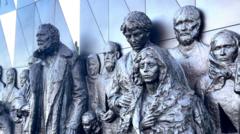
In St. Petersburg, a grand memorial dedicated to “Soviet civilians who fell victim to the Nazi genocide” rises prominently. Completed last year, it features symbolic references, including an eternal flame and inscriptions of infamous concentration camps. However, the discourse surrounding the memorial significantly diverges from traditional Holocaust conversations, which tend to highlight the systematic extermination of Jews during the war.President Vladimir Putin has pivoted the focus from a Jewish-centric Holocaust narrative to the broader suffering of the Soviet populace, citing the loss of over 27 million Soviet lives during the "Great Patriotic War." At the memorial's unveiling, he articulated details of this genocide without explicitly referencing the Holocaust or its context.Putin’s notable absence from this anniversary stems from diplomatic strains with Poland and the West since recent geopolitical conflicts. Whereas his 2005 participation included acknowledgments of the Holocaust as a tragedy for all humanity, the current Russian narrative has increasingly framed the nation as a victim of foreign powers.This shift has raised concerns among historians and Jewish leaders, who fear the marginalization of Jewish suffering in the war. Israel’s Ambassador to Moscow, Simone Halperin, emphasized the need for recognition of the Holocaust as a unique genocide against the Jewish people. The Russian government’s muting of Jewish voices within historical narratives, underlined by titles like “foreign agent” assigned to critical voices, further complicates the landscape.As Russia distances itself from global observances related to the Holocaust, Jewish communities within Russia strive to honor the past, advocating against rising anti-Semitism and distortion of history. Activists argue that it is imperative to educate about the Holocaust to prevent history from repeating itself. With the Auschwitz memorial commemorating liberation this year, the absence of Russian officials sparks a greater debate about remembrance, recognition, and the multifaceted narratives of World War II. The historical definition continues to evoke passionate discussions on identity, victimhood, and collective memory, making clear that the events of the past remain profoundly significant in contemporary society.


