In brief
Farm workers in Oxnard, California, are facing increasing fear and uncertainty following recent immigration raids by ICE agents. With a significant portion of agricultural workers being undocumented, the raids threaten not only their lives but also the stability of food supply chains and local businesses reliant on this workforce.
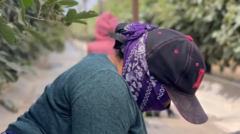
The women remain low to the ground, hidden among the sprawling rows of berry bushes in Oxnard, California—dubbed the "strawberry capital of the world." One of them, a Mexican immigrant, glances around nervously, inquiring, "Are you from ICE?" Her worries stem from a series of recent raids targeting farm workers by U.S. Immigration and Customs Enforcement (ICE), which have escalated over the past week. After confirming that we are not affiliated with ICE, she hesitantly rises to speak. "Have you seen any ICE vans? Are there patrol cars outside?" she asks with trembling anticipation. The undocumented worker, who has been in the U.S. for two years, describes the fear that has taken hold not only of her but of countless colleagues as they cower, waiting to be picked up by hesitant friends after their shifts.Local advocate groups reported that nine farms in the vicinity were visited by ICE in the last week, resulting in 35 arrests on the streets nearby. These enforcement actions are part of a broader initiative by the Trump administration aimed at deporting 3,000 undocumented immigrants each day. Although initially met with support, such measures have prompted public outcry and protests which have at times turned violent, triggering a controversial military presence in Los Angeles."We came here to work, not to be treated like criminals," the woman asserts, having left her children behind in Mexico with the hope of returning soon. "We're afraid to leave our homes or even visit nearby stores." Lucas Zucker, a community organizer based in California's Central Coast, noted the alarming shift in policy; after 15 years of relative calm regarding ICE operations in the agricultural sector, large-scale raids have rapidly returned.With more than 40% of U.S. farm workers considered undocumented, California presents a unique challenge, where estimates suggest that over 75% of these workers belong to that category. Fears mount that further arrests could jeopardize food production, as workers choose to remain in hiding rather than risk capture and deportation.Amidst this crackdown, President Trump acknowledged that farmers are feeling the repercussions of his enforcement policies. He described their undocumented workers, many of whom have been loyal for decades, as valuable but ultimately at risk of removal, adding stress to the agriculture-driven economy.The tension reached a boiling point on Tuesday when a local video captured a man sprinting across a foggy field as ICE agents pursued him. Their visible presence has permeated daily life, with community members spotting law enforcement vehicles outside agricultural businesses.Local businesses are also suffering from the fallout. Raquel Pérez, whose family runs a Mexican restaurant, shared with concern that her customer base has drastically shrunk because farm workers have chosen not to patronize her establishment. "They don’t realize the domino effect this is going to have," she lamented, highlighting a wider impact felt by businesses that depend on the agricultural supply chain.Óscar, a migrant selling strawberries, echoed similar sentiments, revealing that fewer customers are venturing out amid the turmoil. An undocumented worker himself, he worries for his family's future, standing on the brink of finalizing his immigration status but now faced with the uncertainty brought about by ICE's presence.As conditions intensify, local communities remain on edge, pondering the long-term implications of these raids on their lives and livelihoods in an atmosphere already fraught with challenges.