In June 2023, a video started spreading on pro-war Russian social media channels, apparently showing a drone destroying a Ukrainian tank in a massive explosion.
But not everything is what it seems in the Russia-Ukraine war.
That video was followed by Ukrainian footage showing a laughing soldier pointing at the burning wreckage and exclaiming: They've hit my wooden tank!
The tank in question appears to be a plywood decoy used by the Ukrainian forces to deceive the Russians.
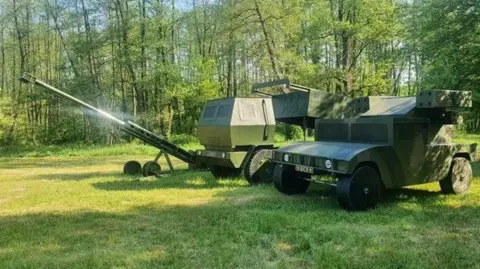
It is one of many thousands of full-scale models of military equipment used by both Ukraine and Russia to trick the enemy into wasting valuable ammunition, time and effort.
Almost anything seen on the frontline - from small radars and grenade launchers to jeeps, trucks, tanks and actual soldiers - may be fake.
These imitations can come in flat-packs, be inflatable, 2D or create a radar illusion of a tank by reflecting radio waves in a special way.
In the case of some weapon types deployed in Ukraine, at least half of them are actually decoy imitations.
Flat-pack artillery
Among the most popular decoys used by the Ukrainian army are models of the British-made M777 howitzers. Western allies are understood to have supplied Kyiv with more than 150 of these highly manoeuvrable and accurate artillery pieces, nicknamed Three Axes by Ukrainian soldiers.
As with many other types of equipment used by the Ukrainian army, volunteers play an important role in supplying decoy mock-ups.
Ruslan Klimenko says his volunteer group Na Chasi alone has made and supplied to Ukrainian forces about 160 models of M777s. What makes them particularly popular is the fact that they take three minutes, two people and no tools to assemble on the front line, Mr Klimenko says. No matter how many are delivered, all will be put to good use, he tells the BBC.
Pavlo Narozhny from another group of volunteers, called Reaktyvna Poshta, says that at any given time 10-15 M777 decoys are in production.
Reaktyvna Poshta's decoys are made of plywood, come in flat packs and cost about $500 - $600.
Russia often targets them with Lancet kamikaze drones costing about $35,000. You do the math, Mr Narozhny says.
One of his M777 decoys, nicknamed Tolya, has spent more than a year on the frontline, surviving hits with at least 14 Lancets, he claims.
Troops keep putting it back together with some sticky tape and screws, and back off to the frontline it goes, Mr Narozhny says.
Wheel ruts and toilets
Much depends on how decoys are deployed. To successfully draw enemy fire, it helps to faithfully recreate a real position complete with wheel ruts, ammunition crates and toilets. When properly done, this can deceive not just the enemy, but visiting officers too.
According to him, another tactic is to quickly remove real cannons such as mortars after use and replace them with decoys.
They're ideal for deceiving the enemy and making them waste expensive resources on nothing. They work, we need more of them, he says.
Russia's arsenal of decoys is also rich and varied.
About half of the drones involved in any of Russia's recent aerial attacks are actually cheap imitations, the Ukrainian military says.
One Russian firm, Rusbal, produces imitations that include 2D decoys to mislead intelligence gathering from the air or space, decoys that mimic the heat given out by engines or radio traffic coming from soldiers' walkie-talkies, and reflectors that fool the enemy's radars.
But of course, decoys are not a new idea in war. Military technology has hugely improved since World War Two. Drones and unmanned systems on the battlefield are a major innovation in this war, for instance.
But no matter what new weapons of destruction make it to the battlefield, it just goes to show that subterfuge and trickery – even with something as simple as a blow-up doll - will always play a part in warfare.